Bridging Event Streams and DiT: Event-Guided Video Frame Interpolation

Guixu Lin1, Yuyang Yu2, Xiang Ji1, Linyao Chen1, Zhengwei Yin1, Mengshun Hu3, Mingdeng Cao1, Shengfeng He4,*, Yinqiang Zheng1,*
1The University of Tokyo   2South China University of Technology   3Wuhan University   4Singapore Management University
*Corresponding authors

Abstract

Latent diffusion models have recently advanced video frame interpolation by synthesizing intermediate frames between input images. However, handling large temporal gaps and complex motion remains challenging, often resulting in motion blur, structural distortions, and temporal inconsistencies. Event cameras provide high-temporal-resolution motion cues that are well suited for bridging these gaps and improving interpolation quality. To exploit this advantage without training an event-assisted model from scratch, we propose an adapter-based framework that incorporates event-derived cues into a pre-trained image-to-video diffusion model with minimal architectural changes. Specifically, our method leverages Image Warped Events (IWEs) and bidirectional sparse optical flow to provide spatially and temporally aligned guidance during generation. By injecting these event-guided structural and motion cues into the diffusion process, our approach reduces interpolation artifacts and improves both reconstruction fidelity and temporal coherence. Experimental results on real and synthetic benchmarks show that our method consistently outperforms existing state-of-the-art approaches. Code is available at GitHub.

Method

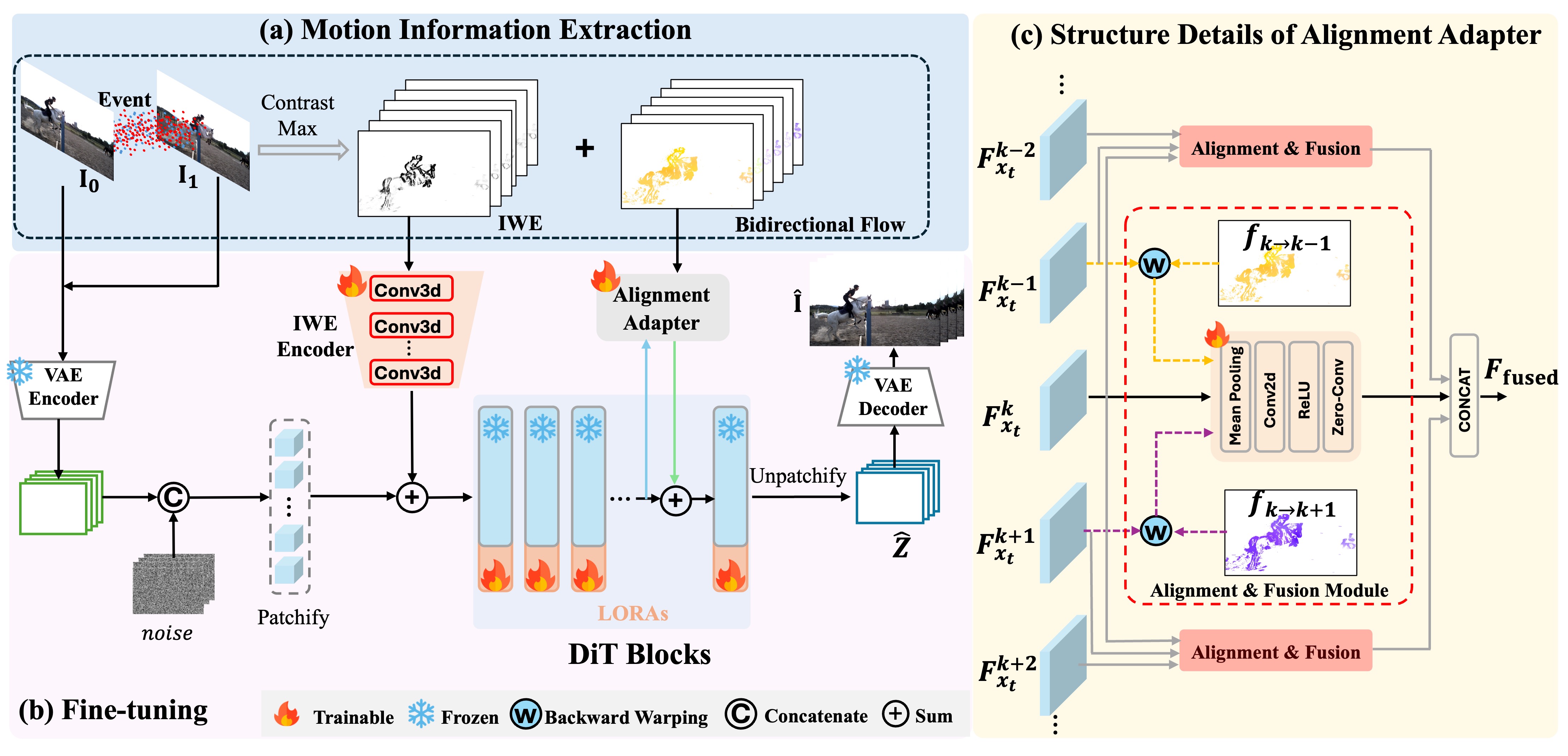
Illustration of Our Framework. (a) We extract bidirectional sparse optical flow and IWEs from the input event stream using the Contrast Maximization (CMax) method. (b) During fine-tuning, the model is enhanced with three components: an IWE encoder, alignment adapters inserted into a subset of DiT blocks, and LoRA layers applied to all DiT blocks. (c) The flow-based alignment adapter leverages the bidirectional flows to warp intermediate features from neighboring frames, aligning them temporally with the current frame. This facilitates motion-consistent feature propagation throughout the denoising process
Baseline comparisons

x 24 interpolation

Input pairs
Ground Truth
Timelens
CBMNet
WAN2.1 FLF2V
Ours
frame 1
frame 1
frame 1
frame 1
frame 1

Baseline comparisons with VDM-EVFI-Wan2.1

x 24 interpolation

VDM-EVFI-Wan2.1
Ours